What Happens When Someone Buys Your Ecommerce Platform

If you run an online store in Australia, there's a decent chance you've felt the ground shift under your feet in the last couple of years. Platforms get acquired. Prices go up. Support gets worse. Features stagnate. The term for this is "enshittification" and it's happening right now to platforms Australian businesses depend on.
I want to talk about two platforms in particular: Neto and BigCommerce. Both are cautionary tales, but in very different ways.
Neto: The Slow Gutting of an Aussie Platform
Neto was a genuinely good Australian ecommerce platform. Founded in Brisbane in 2009, it carved out a solid niche with retailers and wholesalers who needed multichannel selling, inventory management, and B2B features all in one place. Around 3,000 merchants used it. For an Aussie-built platform competing against Shopify, that's impressive.
Then in March 2021, Canadian marketing automation company Maropost bought Neto for $60 million. The press releases were full of "natural synergy" and "unified solutions." The usual stuff.
Here's what actually happened after the acquisition:
Feature updates slowed down. The app ecosystem thinned out. The roadmap went quiet. Support ticket response times blew out to weeks. And merchants started leaving.
One long-term merchant paying $18,000 a year reported that their Amazon product sync broke in April 2024, dropping their listings from 10,000+ to around 1,000. Nearly a year later, still not fixed. The response? "It's a known issue with the integration team."
Another merchant got hit with a 66% price increase with just 10 days' notice. When they tried to cancel, they were told they needed to give 60 days' notice, so they'd be forced to pay the higher rate regardless. They've filed complaints with the ACCC.
As of early 2026, tracking data shows fewer than 2,000 live Neto sites globally, down from about 2,500 a year earlier. The number is declining. Larger Australian brands like TentWorld and OzTrail have already migrated away. There's now a cottage industry of Shopify agencies writing "how to migrate from Neto" guides. When that happens, you know the trajectory.
BigCommerce: Death by a Thousand Cuts
BigCommerce is a different story. Nobody bought it and gutted it. It's more of a slow fade.
BigCommerce went public in 2020 during the COVID SaaS hype. The stock hit around $130. As of April 2026, it's trading under $3. Shopify had a similar dip but recovered and is now trading above $110. BigCommerce (now rebranded as Commerce.com) never bounced back.
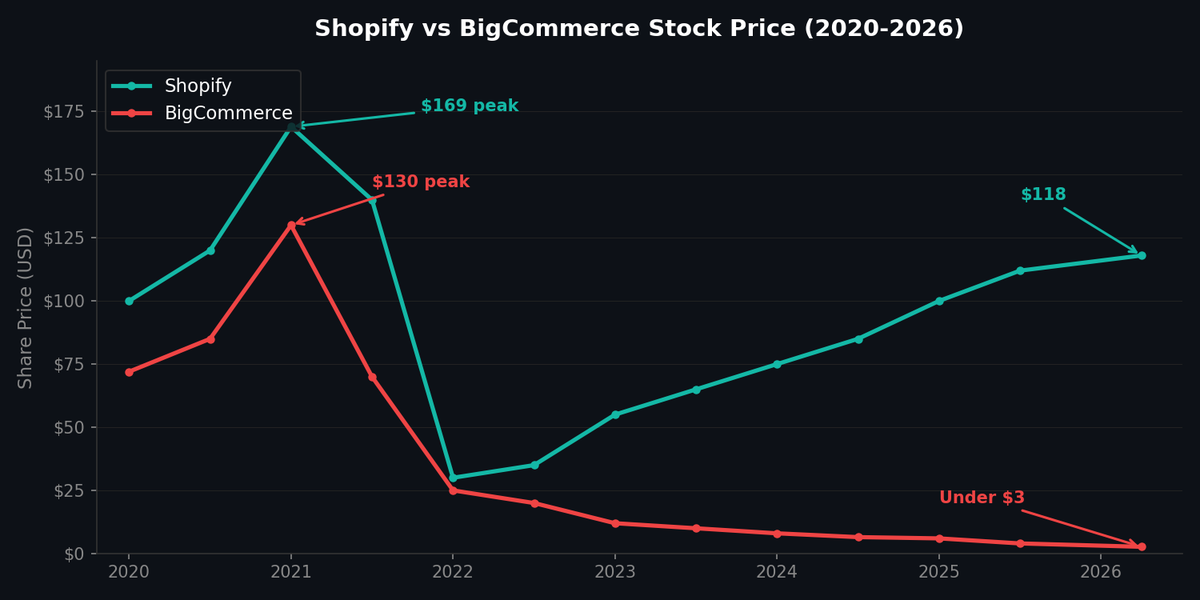
Same crash. One recovered. One didn't.
Google Trends tells the same story from the demand side:
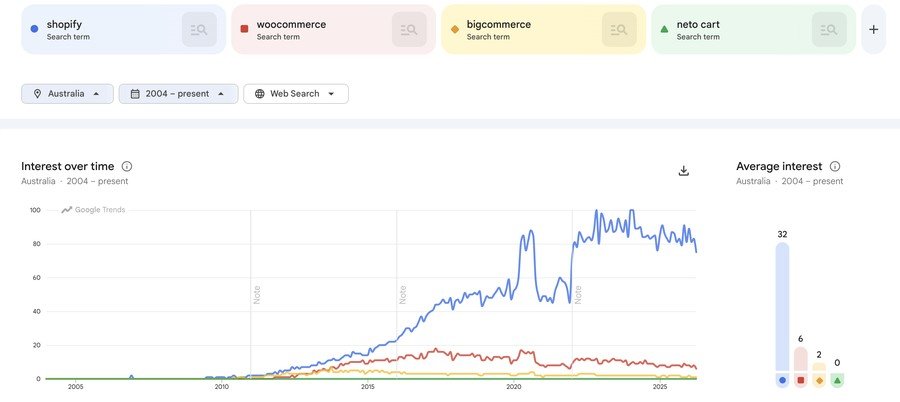
Shopify's search interest in Australia has been climbing for a decade. BigCommerce and Neto barely register.
Just recently, they rejected a second unsolicited acquisition attempt from an AI company called Rezolve, saying the offer significantly undervalued the company. When you're fending off lowball acquisition bids, things aren't going great.
The platform itself hasn't been enshittified in the Neto sense. Nobody's jacking up prices overnight or letting critical integrations rot. But the momentum has stalled. Revenue growth is in the low single digits. They're pivoting hard to enterprise and B2B, which is probably smart, but it leaves smaller merchants wondering about the long-term roadmap.
For Australian businesses specifically, BigCommerce still works fine if you're on it. But if you're choosing a platform today, the question isn't "is it broken?" It's "will this platform still be investing in my segment in three years?"
Meanwhile, Shopify Just Keeps Shipping
I'm not a Shopify evangelist. They have their own problems: transaction fees that sneak up on you, a reliance on paid apps for basic features, and Shopify Plus pricing that makes your eyes water.
But the numbers tell a story. Shopify powers tens of thousands of stores in Australia alone. Revenue hit $11.56 billion in 2025, and profit went from razor-thin to $1.23 billion in a single year. In the last 90 days of reporting, over 20,000 merchants migrated TO Shopify from competitors. Only about 2.2% of merchants leave per year, which is remarkably low for SaaS.
The gap between Shopify and everyone else isn't closing. It's widening.
What This Means For Your Business
If you're currently on Neto, it's time to have a serious conversation about your next move. The platform isn't dead yet, but the trajectory is clear. Don't wait until you're forced to migrate in a rush.
If you're on BigCommerce, don't panic. But keep an eye on it. If the acquisition attempts keep coming and the stock keeps sliding, the calculus could change quickly.
If you're choosing a platform for a new store, the safe bet in 2026 is Shopify for most use cases. WooCommerce if you need maximum flexibility and have the technical chops (or a good dev partner) to maintain it.
At Jezweb, we've been building on WooCommerce and Shopify for years. Not because we predicted any of this, but because we backed platforms that were investing in their own future. WooCommerce is open source, so nobody can acquire it and gut it. Shopify is the clear market leader with the numbers to stay there. Sometimes the best tech decision is just picking the horse that's still running.
The bigger lesson? Be wary of any platform that gets acquired by a company outside its core market. When a marketing automation company buys an ecommerce platform, the ecommerce bit almost always becomes a second-class citizen. It's not malice. It's just how priorities work when the new owners have different goals.
Your online store is your business. The platform it runs on matters more than most people think about until something goes wrong. Pay attention to the signs: slowing updates, declining support quality, aggressive price increases, executive turnover. These aren't just inconveniences. They're warnings.
Worth a conversation if you're thinking about a platform move. Just reply to this email.
-- Jez
Recently built

Micro Skin Newcastle is Belinda's mobile microneedling service across Newcastle and Lake Macquarie. The brief was a single-page site that does everything: explain the treatment, show pricing, handle bookings, answer the awkward questions ("does it hurt? how long am I red for?"). One page, no menu hunting, premium feel. Sometimes one page done properly is better than ten pages of fluff.
Away from the Keyboard

Panda at the park, checking whether the water is worth getting into. It wasn't. He checked again five minutes later just to be sure.
If someone you know would get something out of this, feel free to forward it. And just reply if you want to chat, I read every one.